


|
Chapter 14
|
Глvа, д~і”
|
|
1
|
1
|
|
After three years was Judas informed, that Demetrius the son of Seleucus, having entered by the haven of Tripolis with a great power and navy,
|
Потрїехъ же лњтехъ прїиде въ і^ё^де'искђю стра'нђ. дими'трїи селев#кїев#, съ мно'жествомъ ѕњ'лным#, треX ради гра'довᲆ приста'нищныX
|
|
2
|
2
|
|
had taken the country, and killed Antiochus, and Lysias his protector.
|
и^ ё^держа странђ” и^ ё^би` а^нтїѓ'ха и^ е^го приѓ^бра'ꙁнаго лисїю.
|
|
3
|
3
|
|
Now one Alcimus, who had been high priest, and had defiled himself wilfully in the times of their mingling with the Gentiles, seeing that by no means he could save himself, nor have any more access to the holy altar,
|
а^лкиM же нњ'кто бы'выи пре'жде а^рхїере'и, во'лею же ѓ^скверненъ въ времена` смњшенїя. и^ помышля'я ја%ко никимже ѓ%браꙁомъ нњсть е^мђ сп~сенїа, ниже прихоже'нїя къ ст~омђ ѓ^лтарю`”
|
|
4
|
4
|
|
came to king Demetrius in the hundred and one and fiftieth year, presenting unto him a crown of gold, and a palm, and also of the boughs which were used solemnly in the temple: and so that day he held his peace.
|
Прїиде къ цр~ю дими'трїю, рн~а, лњта. принося е^мђ вњнецъ зла'т# и^ фини'ки, кси'м же и^ цвњти, и^же цр~ковнїи сђще видяхђся. и^ въ дн~ь ѓ%нъ бысть въ млъча'нїи.
|
|
5
|
5
|
|
Howbeit, having gotten opportunity to further his foolish enterprise, and being called into council by Demetrius, and asked how the Jews stood affected, and what they intended, he answered thereunto:
|
ё^смотри' же вре'мя нераꙁђмїю свое^мђ и^ приꙁва'ся дими'трїемъ въ собо'ръ, и^ въпроше'нъ бысᲄь. в кое^мъ раZлоѕе и^ совњтњ стоя'тъ і^ё^де'и,
|
|
6
|
6
|
|
Those of the Jews that be called Assideans, whose captain is Judas Maccabeus, nourish war, and are seditious, and will not let the realm be in peace.
|
ксим же рече. гл~емїи і^ё^де'и а^сиде'и и^хъже во'ждъ і^ё^да, и^ мак#каве'и брани строи'тели и^ ра'спря въздвиза'ютъ не помышля'ютъ црsкаго бл~гостоја%нїя полђчи'ти.
|
|
7
|
7
|
|
Therefore I, being deprived of mine ancestors' honour, I mean the high priesthood, am now come hither:
|
эTню'дђже эTлђчеn е^смь прародительскїя сла'вы. сирqњ сщ~енонача'лъства. гряды'и нн~њ прїидо'хъ.
|
|
8
|
8
|
|
first, verily for the unfeigned care I have of things pertaining to the king; and secondly, even for that I intend the good of mine own citizens: for all our nation is in no small misery through the unadvised dealing of them aforesaid.
|
прьвое ё^бо полеꙁныхъ ради цр~еви вњрђ съдръжа'щи. второ'е же и^ свои^хъ гража'нъ созирая преDреченыхъ ё^бо беꙁъсловесїе, по всемђ роD нашъ не мало ѓ^жесточаеT”
|
|
9
|
9
|
|
Wherefore, O king, seeing thou knowest all these things, be careful for the country, and our nation, which is pressed on every side, according to the clemency that thou readily shewest unto all.
|
Ко'ждо же сихъ ꙁна'ноти бђди ЭO цр~ю ѓ^ странњ` и^ ѓ^ стоя'нїю рода прораꙁђмњ'и. по е^мђже и%маши къ всњм# любочл~чїя бл~госрњте'нїе”
|
|
10
|
10
|
|
For as long as Judas liveth, it is not possible that the state should be quiet.
|
донелиy б^о і^ё^да е^сть невоꙁмо'жно ми'ра полђчи'ти дњтелеи.
|
|
11
|
11
|
|
This was no sooner spoken of him, but others of the king's friends, being maliciously set against Judas, did more incense Demetrius.
|
си'цевым же рече'ннымъ эT него. и^ про'чїи дрђꙁи вра'ждђ и^мђщи на і^ё'дђ, раꙁждего'ша дими'трїя.
|
|
12
|
12
|
|
And forthwith calling Nicanor, who had been master of the elephants, and making him governor over Judea, he sent him forth,
|
приꙁва' же ско'ро никано'ра гл~ема старњ'ишинђ е^лефа'новᲆ и^ вое^водђ поста'ви і^ё^деѓ'м#, и^ посла`
|
|
13
|
13
|
|
commanding him to slay Judas, and to scatter them that were with him, and to make Alcimus high priest of the great temple.
|
да'въ за'повDњ, самаго і^ё'дђ ё^биᲄи і^ и^же с ни'мъ расточи'ти” поста'вити же а^лки'ма а^рхїере'я вели'каго хра'ма”
|
|
14
|
14
|
|
Then the heathen, that had fled out of Judea from Judas, came to Nicanor by flocks, thinking the harm and calamities of the Jews to be their welfare.
|
Тогда` ја^зы'цы ё^бњгшїя въ і^ё^де'ю къ і^ё'де, смњси'шася внеза'пђ съ никаноромъ. хотя'ща і^ё^де'искаго неполђче'нїя и^ бл~говременїя гони'тели бы'ти”
|
|
15
|
15
|
|
Now when the Jews heard of Nicanor's coming, and that the heathen were up against them, they cast earth upon their heads, and made supplication to him that had established his people for ever, and who always helpeth his portion with manifestation of his presence.
|
Слы'шавши же і^ё^де'и никано'рово прише'ствїе, и^ повинове'нїе ја%ꙁы'къ, поко'ивше ꙁеMлю моля'хђ даже до' вњка посᲄа'вльшаго лю'ди своя прsно съ ја^вле'нїемъ въспомага'я свое^я ради ча'сти”
|
|
16
|
16
|
|
So at the commandment of the captain they removed straightways from thence, and came near unto them at the town of Dessau.
|
Повелњвшђ же вое^во'дњ ско'ро эTтђдђ дви'гнђшася, и^ смњси'шася съ страно'ю деса'влею”
|
|
17
|
17
|
|
Now Simon, Judas' brother, had joined battle with Nicanor, but was somewhat discomfited through the sudden silence of his enemies.
|
Си'монъ же братъ і^ё'динъ сътвори` съ никано'роM бра'нь мале же ё^страшися нахожде'нїя раd сђпоста'тъ,
|
|
18
|
18
|
|
Nevertheless Nicanor, hearing of the manliness of them that were with Judas, and the courageousness that they had to fight for their country, durst not try the matter by the sword.
|
ја%коже слыша никаноr мђжество и^же ѓ^ і^ё'де сђщиX, и^ бл~годш~їе и^мже подвиꙁа'юᲄся ꙁа эTч~ество и^ страша'шеся сђда крове ради сътвори'ти”
|
|
19
|
19
|
|
Wherefore he sent Posidonius, and Theodotus, and Mattathias, to make peace.
|
Сего ради посла`, посидо'на, і џеѓ^до'та, и^ маTтаџїа, даᲄи и^ взя'ти десни'цђ”
|
|
20
|
20
|
|
So when they had taken long advisement thereupon, and the captain had made the multitude acquainted therewith, and it appeared that they were all of one mind, they consented to the covenants,
|
На мно'ѕњ же ѓ^ семъ бывшђ совњтђ, и^ вое^во'да къ мно'жествђ и^ꙁнесе. всњмᲆ е^ді'но бысть и^ꙁволе'нїе прїя'ти дрђжбђ.
|
|
21
|
21
|
|
and appointed a day to meet in together by themselves: and when the day came, and stools were set for either of them,
|
и^ нареко'ша дн~ь во'ньже на ё^е^дине'нїе сни'дђтся, и^ прїиде, и^ поста'виша комђждо сњда'лище”
|
|
22
|
22
|
|
Judas placed armed men ready in convenient places, lest some treachery should be suddenly practised by the enemies: so they made a peaceable conference.
|
Повелњ же і^ё'да въѓ^рђженымъ быти гото'воM въ мњстњ подо'бнњ, да не когда эT сђпоста'тъ внеꙁа'пђ ѕлодњянїе бђдеT и^ съвръше'нђ бесњдђ сътвори'ша.
|
|
23
|
23
|
|
Now Nicanor abode in Jerusalem, and did no hurt, but sent away the people that came flocking unto him.
|
пребысть же никано'ръ въ і^ерsлимњ, и^ никое^гоже ѕла` сътвори`. ста'да же народовъ събра'нныхъ эTпђсти`”
|
|
24
|
24
|
|
And he would not willingly have Judas out of his sight: for he loved the man from his heart.
|
И$мњяше же і^ё'дђ всегда` въ лицы` и^ дш~евне прилежа'ше мђжђ.
|
|
25
|
25
|
|
He prayed him also to take a wife, and to beget children: so he married, was quiet, and took part of this life.
|
молиy е^го жени'тися и^ ча'да сътвори'ти. и^ ѓ^женься бл~гостояше и^ соѓ^бщися жи'тїю”
|
|
26
|
26
|
|
But Alcimus, perceiving the love that was betwixt them, and considering the covenants that were made, came to Demetrius, and told him that Nicanor was not well affected toward the state: for that he had ordained Judas, a traitor to his realm, to be the king's successor.
|
А$лким же ви'дящи межDђ и^ма бл~гораꙁђмїе и^ бы'вшая совњща'нїя” Прїиде къ дими'трїю и^ гл~аше, никанора вещемъ чюждим# мђдръствова'ти” і^ё^дђ же совњт#ника црsтва свое^го въспрїяти.
|
|
27
|
27
|
|
Then the king being in a rage, and provoked with the accusations of the most wicked man, wrote to Nicanor, signifying that he was much displeased with the covenants, and commanding him that he should send Maccabeus prisoner in all haste unto Antioch.
|
цр~ь же възја^ри'ся, и^ стропти'выми ѓ^клевета'нїи е^го раꙁъсверњпњ” писа` никано'рђ рекђщи. ѓ^ ꙁавњща'нїяхъ сихъ тя'жко ми е^сть носити. повелњва'ю же т^и мак#кавея свяꙁанA посла'ти к на'мъ въ а^нтїѓхїю”
|
|
28
|
28
|
|
When this came to Nicanor's hearing, he was much confounded in himself, and took it grievously that he should make void the articles which were agreed upon, the man being in no fault.
|
Оу^вњдњ же ѓ^ си'хъ никано'ръ и^ смятеся и^ бњдне пребыва'ше. не хотя эTврещися ꙁавњща'наго, ꙁане` ничто'же видњ ѓ^би'дна въ мђжи.
|
|
29
|
29
|
|
But because there was no dealing against the king, he watched his time to accomplish this thing by policy.
|
н^о понеже цр~ю съпротивиᲄися не бᲇ бл~говре'мя снабдя'ше воиnствоM сїя сᲆвершити”
|
|
30
|
30
|
|
Notwithstanding, when Maccabeus saw that Nicanor began to be churlish unto him, and that he entreated him more roughly than he was wont, perceiving that such sour behaviour came not of good, he gathered together not a few of his men, and withdrew himself from Nicanor.
|
Мак#каве'и же ви'дящи собою грознње дња'ти никанора, ѓ^бычное срњтнїе ѕвᲇрско і^мђща. разђмᲇ не эT блажа'иша быᲄи прещенїя с^и, собра` нема'ло и^же ѓ%крsтъ себе, и^ съкрыся эT никанора.
|
|
31
|
31
|
|
But the other, knowing that he was notably prevented by Judas' policy, came into the great and holy temple, and commanded the priests, that were offering their usual sacrifices, to deliver him the man.
|
позна' же дрђгъ е^го ја%ко роDнњише эT мђжа ратђ'ется, прїиде къ вели'комђ и^ ст~омђ хра'мђ, и^ въꙁнося'щиM подобныя жертвы повелњ преда'ти мђжа”
|
|
32
|
32
|
|
And when they sware that they could not tell where the man was whom he sought,
|
И$м#же е^гда` съ кля'твою рекшимъ не вњдњти ка'мо е^сть и^ще'мыи. и^ простерᲆ рђкђ на цр~ковъ кляTся рекђщи,
|
|
33
|
33
|
|
he stretched out his right hand toward the temple, and made an oath in this manner: If ye will not deliver me Judas as a prisoner, I will lay this temple of God even with the ground, and I will break down the altar, and erect a notable temple unto Bacchus.
|
а^ще не предасте ми свя'зана і^ё'дђ. т^о бж~їи храM в равнинђ сᲆтворђ и^ ѓ'лтарь раскопа'ю, и^ капище дїѓнисїю сътворю зде`.
|
|
34
|
34
|
|
After these words, he departed. Then the priests lifted up their hands toward heaven, and besought him that was ever a defender of their nation, saying in this manner;
|
и^ сїя рекъ эTи'де” Жръцы же въꙁдњ'юще рђцњ на' нб~о призывахђ строи'теля и^ съпоборьника јаꙁыка и^хъ, сђщаго всегда, сїя рекђщи”
|
|
35
|
35
|
|
Thou, O Lord of all things, who hast need of nothing, wast pleased that the temple of thine habitation should be among us:
|
Ты г~и всњхъ сы'и, не требђ'яи ничᲄоже бл~говолил# е^си храмъ ѓ^бита'нїя твое^го быти в насъ”
|
|
36
|
36
|
|
therefore now, O holy Lord of all holiness, keep this house ever undefiled, which lately was cleansed, and stop every unrighteous mouth.
|
И$ нн~њ ЭO ст~е всякого ѓ^сщ~енїя и^ г~и, съхрани въ вњк# несквернеn храмъ твои секраты ѓ^чищеныи” загради' же всяка ё^ста` неправеDна.
|
|
37
|
37
|
|
Now was there accused unto Nicanor one Razis, one of the elders of Jerusalem, a lover of his countrymen, and a man of very good report, who for his kindness was called a father of the Jews.
|
разїи же нњ'кто ста`рецъ эT і^ерsли'ма ѓ^клеветаn бысть никанорђ” Мђжᲆ любополитъ и^ ѕњло добрњсло'выи. и^ по бл~гораꙁђмїю эTц~ъ і^ё^деѓ^мъ и^меновашеся”
|
|
38
|
38
|
|
For in the former times, when they mingled not themselves with the Gentiles, he had been accused of Judaism, and did boldly jeopard his body and life with all vehemency for the religion of the Jews.
|
Бысть б^о въ прежниX временеX смњшенїя сђдъ внося і^ё^де'иства ради си'цевъ, ја%котњло и^ дш~ђ предаа'ше съ всякимᲆ прилњжанїемъ”
|
|
39
|
39
|
|
So Nicanor, willing to declare the hate that he bare unto the Jews, sent above five hundred men of war to take him:
|
Хотя'ше же ника'норъ и^ꙁ#вњстно ја^вити не'нависть ю%же и^мњ на і^ё^де'и, посла` во'инъ пять соT ја%ти е^го.
|
|
40
|
40
|
|
for he thought by taking him to do the Jews much hurt.
|
мняше б^о ѓ%наго ја%вши сиM съдњлати по'лезная.
|
|
41
|
41
|
|
Now when the multitude would have taken the tower, and violently broken into the outer door, and bade that fire should be brought to burn it, he being ready to be taken on every side fell upon his sword;
|
мно'жествђ же хотя'щђ столпъ раскопа'ти и^ дворныи двери раꙁдрђша'ющи, і^ повелњша ѓ%гнь принести и^ двери зажещи” Є$гда` и^маше е^го мечемъ ся пораѕи.
|
|
42
|
42
|
|
choosing rather to die manfully, than to come into the hands of the wicked, to be abused otherwise than beseemed his noble birth:
|
лђче хотя ё%мрети неже л^и врагомъ поDрђчникᲆ быти, и^ свое` бл~гороDство ѓ^беZчестиᲄи.
|
|
43
|
43
|
|
but missing his stroke through haste, the multitude also rushing within the doors, he ran boldly up to the wall, and cast himself down manfully among the thickest of them.
|
скоростиy ради не смр~тна ја%зва бысть, наро'доM же двери раꙁбива'ющимъ, ѓ%н# же притекъ дръзновенне на стњнђ сверже самъ себе мђжествено наро'ды,
|
|
44
|
44
|
|
But they quickly giving back, and a space being made, he fell down into the midst of the void place.
|
ѓ^ни же а%бїе разбњгошася паденїя е^го ради. и^ паде посредњ и^хъ.
|
|
45
|
45
|
|
Nevertheless, while there was yet breath within him, being inflamed with anger, he rose up; and though his blood gushed out like spouts of water, and his wounds were grievous, yet he ran through the midst of the throng; and standing upon a steep rock,
|
е^ще же дыхаше разжеn дш~ею воста`, кро'виy е^го ѕᲇлне текђщи, и^ тяжча'ишими ранами бысть ја%звенъ. и^ теча` нароD прои^де,
|
|
46
|
46
|
|
when as his blood was now quite gone, he plucked out his bowels, and taking them in both his hands, he cast them upon the throng, and calling upon the Lord of life and spirit to restore him those again, he thus died.
|
и^ ста` на нњ'коемъ ка'мени высоцњ, и^ ё^же беZ кро'ви бысть” ѓ^бъя'тъ внђтренњя своя` ѓ^бњма рђка'ма врьжеся на наро'ды. възыва'ю^щи владђщаго животоM и^ дх~омъ. сїя е^мђ` па'ки воздати, и^ сиM ѓ%бразоM живота` гонзе”
|
Категорії
Паперові видання
Old Testament
• Gen. • Exod. • Lev. • Num. • Deut.
• Josh. • Judg. • Ruth • 1 Sam. • 2 Sam. • 1 Kgs. • 2 Kgs. • 1 Chr. • 2 Chr. • Ezra • 2 Ezra • 3 Ezra • Neh. • Tob. • Jud. • Esth. • 1 Mac. • 2 Mac. • 3 Mac.
• Job • Ps. • Prov. • Eccl. • Song • Wisd. • Sir.
• Isa. • Jer. • Lam. • Let. Jer. • Bar. • Ezek. • Dan.
• Hos. • Joel • Amos • Obad. • Jonah • Mic. • Nah. • Hab. • Zeph. • Hag. • Zech. • Mal.
Вивчаєте англійську?
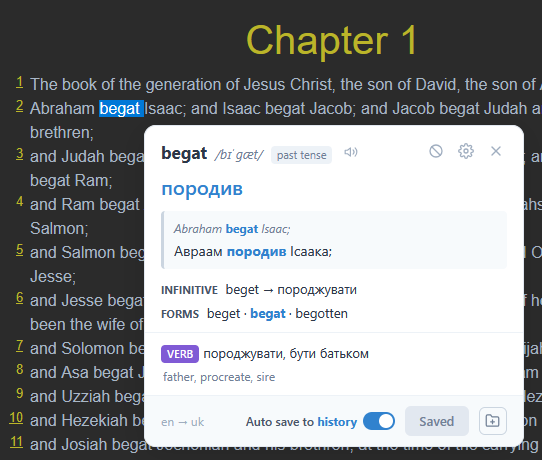
Встановіть розширення Notelang, щоб зручно перекладати незнайомі слова під час читання та зберігати їх у свій словник.


Паперові видання
Old Testament
• Gen. • Exod. • Lev. • Num. • Deut.
• Josh. • Judg. • Ruth • 1 Sam. • 2 Sam. • 1 Kgs. • 2 Kgs. • 1 Chr. • 2 Chr. • Ezra • 2 Ezra • 3 Ezra • Neh. • Tob. • Jud. • Esth. • 1 Mac. • 2 Mac. • 3 Mac.
• Job • Ps. • Prov. • Eccl. • Song • Wisd. • Sir.
• Isa. • Jer. • Lam. • Let. Jer. • Bar. • Ezek. • Dan.
• Hos. • Joel • Amos • Obad. • Jonah • Mic. • Nah. • Hab. • Zeph. • Hag. • Zech. • Mal.
Вивчаєте англійську?
Встановіть розширення Notelang, щоб зручно перекладати незнайомі слова під час читання та зберігати їх у свій словник.