


|
Chapter 13
|
Глvа, г~і”
|
|
1
|
1
|
|
He that toucheth pitch shall be defiled therewith; and he that hath fellowship with a proud man shall be like unto him.
|
Касая'ся пеклњ ѓ^черниTся, и^ ѓ^бща'яся гордомђ точенᲆ е^мђ бђдеT”
|
|
2
|
2
|
|
Burden not thyself above thy power while thou livest; and have no fellowship with one that is mightier and richer than thyself: for how agree the kettle and the earthen pot together? for if the one be smitten against the other, it shall be broken.
|
Бремене па'че себе не въꙁдвижи, и^ крњпльшђ и^ богатњ'ишђ себе` не ѓ^бща'ися”
|
|
3
|
3
|
|
The rich man hath done wrong, and yet he threateneth withal: the poor is wronged, and he must intreat also.
|
Кое' причастїе горнъцђ с котломъ, то'и б^о прираꙁится и то'и сᲆкрђшиTся”
|
|
4
|
4
|
|
If thou be for his profit, he will use thee; but if thou have nothing, he will forsake thee.
|
бога'тыи ѓ^би'дђ тво'ритъ и^ се'и прираꙁгнњва'ется, ни'щїи б^о ѓ^би'димыи самъ примолиTся.
|
|
5
|
5
|
|
If thou have any thing, he will live with thee: yea, he will make thee bare, and will not be sorry for it.
|
а^ще ключимъ бђ'деши кђе^тъ на' тя, а^ще лишенъ бђдеши ѓ^ста'витъ т^я.
|
|
6
|
6
|
|
If he have need of thee, he will deceive thee, and smile upon thee, and put thee in hope; he will speak thee fair, and say, What wantest thou?
|
а^ще л^и и%маши поживеT с тобо'ю, і^ и^стощитъ т^я и^ самъ не поболитъ.
|
|
7
|
7
|
|
And he will shame thee by his meats, until he have drawn thee dry twice or thrice, and at the last he will laugh thee to scorn: afterward, when he seeth thee, he will forsake thee, and shake his head at thee.
|
а^ще требњ бђдетъ т^и эTльститъ т^я и^ въсмње^тъ ти ся, и^ да'сть т^и надеждђ въꙁ#гл~етъ т^и до'брњ”
|
|
8
|
8
|
|
Beware that thou be not deceived, and brought down in thy jollity.
|
И$ речеT т^и е%сть л^и ти` чт^о требњ, и^ посрамиT т^я бра'шномъ свои^мъ, до'ндеже и^стощитъ т^я два'щи и^ли трищи. и^ напослњдок# порђга'етъ ти ся,
|
|
9
|
9
|
|
If thou be invited of a mighty man, withdraw thyself, and so much the more will he invite thee.
|
потоM ѓ^ꙁриT т^я и^ ѓ^ста'витъ т^я, и^ главо'ю свое'ю покива'етъ на' тя”
|
|
10
|
10
|
|
Press thou not upon him, lest thou be put back; stand not far off, lest thou be forgotten.
|
Внима'и и^ не ꙁаблђди,
|
|
11
|
11
|
|
Affect not to be made equal unto him in talk, and believe not his many words: for with much communication will he tempt thee, and smiling upon thee will get out thy secrets:
|
да не смиришися въ веселїи свое^мъ”
|
|
12
|
12
|
|
but cruelly he will lay up thy words, and will not spare to do thee hurt, and to put thee in prison.
|
Є$гда` т^я си'лныи приꙁовеT эTстђпа'и, и^ толи'ко паq приꙁовеT т^я.
|
|
13
|
13
|
|
Observe, and take good heed, for thou walkest in peril of thy overthrowing: when thou hearest these things, awake in thy sleep.
|
не напада'и да не эTринешися, и^ не ста'и эTдалече да не ꙁабвеn бђдеши.
|
|
15
|
14
|
|
Every beast loveth his like, and every man loveth his neighbour.
|
не належи ра'венъ бы'ти с ниM, и^ не вњрђи множа'ишимᲆ словесемъ е^го. мно'гою бе'сњдою и^скђситъ т^я, и^ ја%ко смњя'ся и^спыта'етъ т^я”
|
|
16
|
15
|
|
All flesh consorteth according to kind, and a man will cleave to his like.
|
БеZмлsтивъ е^сть не съблюда'яи словеs, и^ не пощадитъ ѓ^слабити ѓ^ зло'бњ и^ ѓ^ ё'заX”
|
|
17
|
16
|
|
What fellowship hath the wolf with the lamb? so the sinner with the godly.
|
Съблюди и^ внима'и ѕᲇло, ја%ко с паденїемъ свои^мъ хо'диши”
|
|
18
|
17
|
|
What agreement is there between the hyena and a dog? and what peace between the rich and the poor?
|
|
|
19
|
18
|
|
As the wild ass is the lion's prey in the wilderness: so the rich eat up the poor.
|
|
|
20
|
19
|
|
As the proud hate humility: so doth the rich abhor the poor.
|
Всяко животно лю'битъ подобнаго себњ, и^ всякъ чл~къ и^скреняго свое^го”
|
|
21
|
20
|
|
A rich man beginning to fall is held up of his friends: but a poor man being down is thrust also away by his friends.
|
Всяка пло'ть по родђ ся сᲆбира'етъ, и подобнњмъ себњ прилепиTся мђжъ”
|
|
22
|
21
|
|
When a rich man is fallen, he hath many helpers: he speaketh things not to be spoken, and yet men justify him: the poor man slipped, and yet they rebuked him too; he spake wisely, and could have no place.
|
Ка'я ѓ^бщина во'лкђ съ а%гнецемъ, та'коже и^ грњшникђ съ бл~говњрнымъ”
|
|
23
|
22
|
|
When a rich man speaketh, every man holdeth his tongue, and, look, what he saith, they extol it to the clouds: but if the poor man speak, they say, What fellow is this? and if he stumble, they will help to overthrow him.
|
Кїи ми'ръ ё^е'нᲇ съ ўом#, и^ кїи ми'ръ бога'томђ съ ё^бо'гимъ”
|
|
24
|
23
|
|
Riches are good unto him that hath no sin, and poverty is evil in the mouth of the ungodly.
|
Ловъ львовъ ѓ^нагри въ пђсты'ни, та'коже па'жити бога'тымъ ё^богїи”
|
|
25
|
24
|
|
The heart of a man changeth his countenance, whether it be for good or evil.
|
Мерзоко го'рдомђ смиренїе, сице мерꙁокъ бога'томђ ни'щїи.
|
|
26
|
25
|
|
A cheerful countenance is a token of a heart that is in prosperity; and the finding out of parables is a wearisome labour of the mind.
|
богаT колњ'бляся ё^твержае^тся дрђги, ё^богїи же спадеся прирњянъ бђдетъ дрђ'ги”
|
Категорії
Паперові видання
Old Testament
• Gen. • Exod. • Lev. • Num. • Deut.
• Josh. • Judg. • Ruth • 1 Sam. • 2 Sam. • 1 Kgs. • 2 Kgs. • 1 Chr. • 2 Chr. • Ezra • 2 Ezra • 3 Ezra • Neh. • Tob. • Jud. • Esth. • 1 Mac. • 2 Mac. • 3 Mac.
• Job • Ps. • Prov. • Eccl. • Song • Wisd. • Sir.
• Isa. • Jer. • Lam. • Let. Jer. • Bar. • Ezek. • Dan.
• Hos. • Joel • Amos • Obad. • Jonah • Mic. • Nah. • Hab. • Zeph. • Hag. • Zech. • Mal.
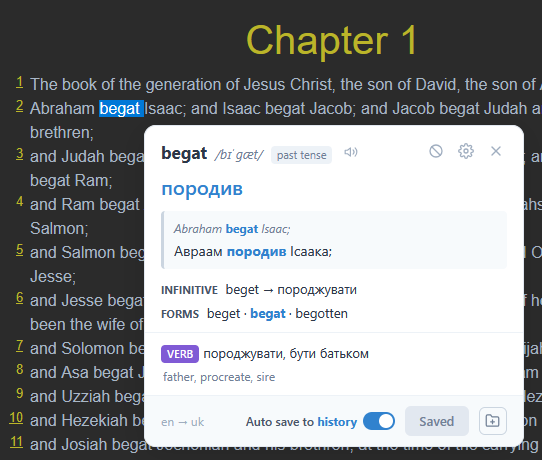
Вивчаєте англійську?
Встановіть розширення Notelang, щоб зручно перекладати незнайомі слова під час читання та зберігати їх у свій словник.



Паперові видання
Old Testament
• Gen. • Exod. • Lev. • Num. • Deut.
• Josh. • Judg. • Ruth • 1 Sam. • 2 Sam. • 1 Kgs. • 2 Kgs. • 1 Chr. • 2 Chr. • Ezra • 2 Ezra • 3 Ezra • Neh. • Tob. • Jud. • Esth. • 1 Mac. • 2 Mac. • 3 Mac.
• Job • Ps. • Prov. • Eccl. • Song • Wisd. • Sir.
• Isa. • Jer. • Lam. • Let. Jer. • Bar. • Ezek. • Dan.
• Hos. • Joel • Amos • Obad. • Jonah • Mic. • Nah. • Hab. • Zeph. • Hag. • Zech. • Mal.
Вивчаєте англійську?
Встановіть розширення Notelang, щоб зручно перекладати незнайомі слова під час читання та зберігати їх у свій словник.