


|
Chapter 29
|
Глvа, к~џ”
|
|
1
|
1
|
|
A reprover is better than a stiff-necked man: for when the latter is suddenly set on fire, there shall be no remedy.
|
Лђче мђжъ ѓ^блича'я мђж'а жестовыина, въ ма'лњ б^о полꙁђ'ющемђ нњсть и^сцњленїя”
|
|
2
|
2
|
|
When the righteous are praised, the people will rejoice: but when the ungodly rule, men mourn.
|
Похваленомъ быва'ющимъ пра'веDнымъ въꙁвеселя'тся лю'дїе, кня'ѕем же нечестивымъ станTђ мђжїе.
|
|
3
|
3
|
|
When a man loves wisdom, his father rejoices: but he that keeps harlots will waste wealth.
|
мђж'ђ любящђ премђдрость веселиTся эTц~ъ е^го, а и'же пасетъ любодњица погђбитъ бога'тесᲄво свое.
|
|
4
|
4
|
|
A righteous king establishes a country: but a transgressor destroys it.
|
цр~ь пра'ведеn ѓ^гои'тъ ꙁе'млю, мђжъ же зако'нопрестђпникъ раскђта'етъ.
|
|
5
|
5
|
|
He that prepares a net in the way of his own friend, entangles his own feet in it.
|
и^же содњва'етъ на лицы свое^мђ дрђгђ мре'жю, ѓ^благаеT ѓ^ свое'и но'ѕњ.
|
|
6
|
6
|
|
A great snare is spread for a sinner: but the righteous shall be in joy and gladness.
|
согрњша'ющемђ мђжђ ве'лїя сњть, пра'веDнїи же въ ра'дости и^ въ веселїи бђдђтъ.
|
|
7
|
7
|
|
A righteous man knows how to judge for the poor: but the ungodly understands not knowledge; and the poor man has not an understanding mind.
|
ё^мње^тъ пра'веDныи сђдъ творити ё^боги'мъ, а^ нечестивїи не раꙁђмњютъ ра'ꙁђма, и^ ё^богомђ не быти ё^хо раꙁђмњва'юще”
|
|
8
|
8
|
|
Lawless men burn down a city: but wise men turn away wrath.
|
Мђжи беꙁаконнїи раждиѕа'ютъ граD, мђжи же мђдрїи въꙁвраща'юT гнvњ”
|
|
9
|
9
|
|
A wise man shall judge nations: but a worthless man being angry laughs and fears not.
|
Мђжъ мђдръ сђдитъ ја^зы'комъ, мђжъ же досади'тель гнњ'ваяся посрамля'ется и^ не ё^бои^тся.
|
|
10
|
10
|
|
Bloody men hate a holy person, but the upright will seek his soul.
|
мђжи кро'ви сђще причастници въꙁненави'дятъ прпDбныя, пра'вїи же възы'щђтъ дш~а и^х#.
|
|
11
|
11
|
|
A fool utters all his mind: but the wise reserves his in part.
|
весь гнњвъ свои и^ꙁно'ситъ беꙁђмныи, премђдрыи же съкрыва'етъ въ ча'сти”
|
|
12
|
12
|
|
When a king hearkens to unjust language, all his subjects are transgressors.
|
Цр~ю послђша'ющђ словесе непра'веDна, вс^и поD нимъ ꙁако'нопрестђпницы.
|
|
13
|
13
|
|
When the creditor and debtor meet together, the Lord oversees them both.
|
ꙁаи^модавцђ и^ длъжникђ е^ді'нъ съ дрђгимъ съшеDшемася, посещенїе ᲄво'ритъ ѓ^бњма г~ь.
|
|
14
|
14
|
|
When a king judges the poor in truth, his throne shall be established for a testimony.
|
цр~ю въи%стиннђ сђдя'щђ ни'щимъ, прsтлъ е^го въ свњдњтельствњ ё^строиTся.
|
|
15
|
15
|
|
Stripes and reproofs give wisdom: but an erring child disgraces his parents.
|
ја%ꙁвыy и^ ѓ^блеченїя да'ютъ мђдрость, ѓ%трокъ же блђдя'и срамляетᲆ роди'теля своя”
|
|
16
|
16
|
|
When the ungodly abound, sins abound: but when they fall, the righteous are warned.
|
Мно'гомъ грњшникоM сђщимъ мно'ѕи грњси бываюT, пра'веDнїи же ѓ^ немъ пада'ющемъ ё^страбля'ютъ себе”
|
|
17
|
17
|
|
Chasten thy son, and he shall give thee rest; and he shall give honour to thy soul.
|
Накаꙁа'и сн~а и^ покои'тъ т^я, и^ дасть лњпотђ твое'и дш~и”
|
|
18
|
18
|
|
There shall be no interpreter to a sinful nation: but he that observes the law is blessed.
|
Не бђдетъ въ па'мять въ ја^ꙁы'цњ ꙁаконопрестђпнњ, а^ храняи ꙁаконъ блаженъ бђдетъ”
|
|
19
|
19
|
|
A stubborn servant will not be reproved by words: for even if he understand, still he will not obey.
|
Не накажется словесы рабъ жестокъ, а^ще б^о и^ раꙁђмњеT н^о не послђшаеT”
|
|
20
|
20
|
|
If thou see a man hasty in his words, know that the fool has hope rather than he.
|
А$ще л^и ви'диши мђжа напра'сна въ словесњхъ, и^ раꙁђмњи ја%ко ё^пова'нїе и%маᲄь паче е^го беꙁђмныи”
|
|
21
|
21
|
|
He that lives wantonly from a child, shall be a servant, and in the end shall grieve over himself.
|
И$же ласкосердъ бђдетъ, эT ѓ^трочины поработится, послњди же ѓ^страстится ѓ^ сеM.
|
|
22
|
22
|
|
A furious man stirs up strife, and a passionate man digs up sin.
|
мђжъ прогнњвав#ся побњжденїе въздвиѕа'ет#, и^ мђжъ жестосердъ эTкрыва'етъ грњхи.
|
|
23
|
23
|
|
Pride brings a man low, but the Lord upholds the humble-minded with honour.
|
досажденїе мђжа смиря'етъ, а^ смиренныя ё^твержа'етъ г~ь вᲆ сла'вњ”
|
|
24
|
24
|
|
He that shares with a thief, hates his own soul: and if any having heard an oath uttered tell not of it,
|
И$же раздњля'ет# коры'сти сᲆ та'теM, ненави'дит# свое'я дш~а. а^ще же присяѕе прилегши, слы'шавше не повњдятъ
|
|
25
|
25
|
|
they fearing and reverencing men unreasonably have been overthrown, but he that trusts in the Lord shall rejoice. Ungodliness causes a man to stumble: but he that trusts in his master shall be safe.
|
ё^боа'вшеся” и^ постыдњвшеся чл~къ претъкнђтся, надњя'вся на г~а възвеселиTся. нечестїе мђжђ даеT соблажненїе, ё^пова'аи же на владђщаго сп~сется.
|
|
26
|
26
|
|
Many wait on the favour of rulers; but justice comes to a man from the Lord.
|
мно'ѕи ё^гажда'ютъ преD лицемъ во'ждеи, эT г~а же събыва'ется пра'вда мђж'ђ”
|
|
27
|
27
|
|
A righteous man is an abomination to an unrighteous man, and the direct way is an abomination to the sinner.
|
Мерꙁость пра'веDникђ мђжъ неправеденъ, мерꙁость же ꙁаконопресᲄђпномђ и^справля'ющїися пђть. и^справля'я пђти своа и^же съ татеM причаща'ется, дш~ђ свою ꙁаклина'ю^щаго слђша'етъ и^ не ска'жетъ” И$же боиTся чл~ка скоро раꙁдрђшиTся, иже ё^пова'етᲆ на г~а въꙁдви'гнеTся. мно'ѕи въꙁы'щђтᲆ лица нача'лника и^ сђ'ди эT г~а и^схо'дитъ е^ді'нымᲆ. меrзятся пра'веDнїи мђжа нечестива, и^ мерꙁятся нечестивїи и%хже пра'ва сђть пђти. сн~ъ сохраняя слово эTц~а свое^го внњ` погђбленїа бђдеT.
|
Категорії
Паперові видання
Old Testament
• Gen. • Exod. • Lev. • Num. • Deut.
• Josh. • Judg. • Ruth • 1 Sam. • 2 Sam. • 1 Kgs. • 2 Kgs. • 1 Chr. • 2 Chr. • Ezra • 2 Ezra • 3 Ezra • Neh. • Tob. • Jud. • Esth. • 1 Mac. • 2 Mac. • 3 Mac.
• Job • Ps. • Prov. • Eccl. • Song • Wisd. • Sir.
• Isa. • Jer. • Lam. • Let. Jer. • Bar. • Ezek. • Dan.
• Hos. • Joel • Amos • Obad. • Jonah • Mic. • Nah. • Hab. • Zeph. • Hag. • Zech. • Mal.
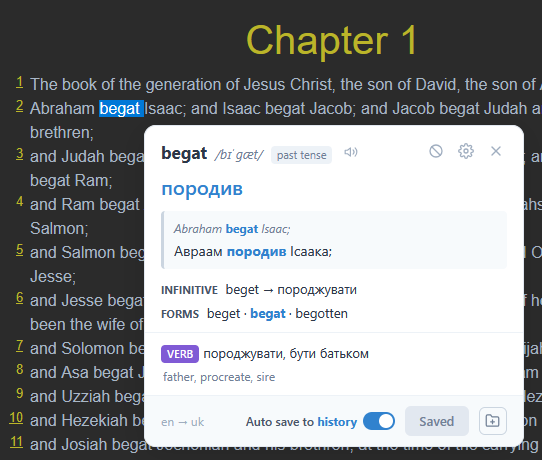
Вивчаєте англійську?
Встановіть розширення Notelang, щоб зручно перекладати незнайомі слова під час читання та зберігати їх у свій словник.


Паперові видання
Old Testament
• Gen. • Exod. • Lev. • Num. • Deut.
• Josh. • Judg. • Ruth • 1 Sam. • 2 Sam. • 1 Kgs. • 2 Kgs. • 1 Chr. • 2 Chr. • Ezra • 2 Ezra • 3 Ezra • Neh. • Tob. • Jud. • Esth. • 1 Mac. • 2 Mac. • 3 Mac.
• Job • Ps. • Prov. • Eccl. • Song • Wisd. • Sir.
• Isa. • Jer. • Lam. • Let. Jer. • Bar. • Ezek. • Dan.
• Hos. • Joel • Amos • Obad. • Jonah • Mic. • Nah. • Hab. • Zeph. • Hag. • Zech. • Mal.
Вивчаєте англійську?
Встановіть розширення Notelang, щоб зручно перекладати незнайомі слова під час читання та зберігати їх у свій словник.